How much does surgery actually cost without insurance?
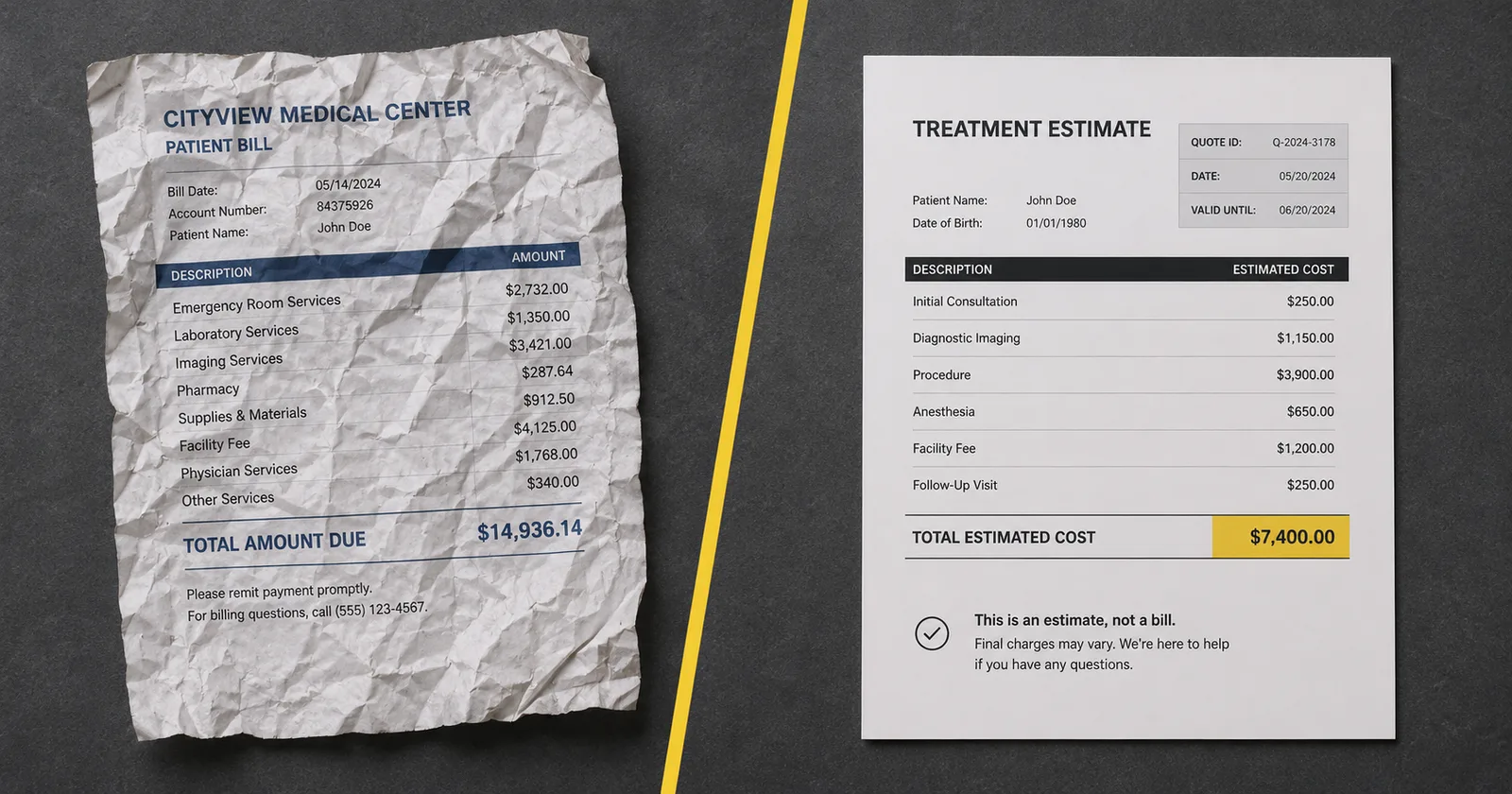
If you're uninsured and you ask a US hospital what a surgery costs, the first number you hear is usually fiction. It's the chargemaster rate — a list price that insurers never pay and that exists mostly as a negotiating anchor. Uninsured patients are billed that inflated number by default, and the single most valuable thing you can learn is this: you have to ask for the cash price. It is not offered; it is requested.
The three prices every procedure has
Every US procedure effectively carries three different prices, and conflating them is the biggest source of misleading cost numbers online:
- Chargemaster (billed) charges — the hospital's list price. Largely fictional for insured patients, but exactly what an uninsured patient is billed unless they intervene.
- Self-pay / cash rate — the real number. Obtained by asking for the "self-pay," "cash," or "prompt-pay" rate, or by using a transparent-price provider. Rule of thumb from multiple billing sources: 40–70% below billed charges.
- Insurer-negotiated rate — what a health plan pays. Useful context, but not a price you can access without the plan.
Where the real cash prices live
Freestanding ambulatory surgery centers (ASCs). Per CMS payment comparisons cited across cost analyses, ASCs charge on average 60–80% less than hospital outpatient departments for the identical procedure. The Surgery Center of Oklahoma is the most famous example — it posts flat, all-inclusive prices online: total knee replacement $17,679, gallbladder removal $6,836, ACL repair $7,931, cataract $4,800 per eye. One price, covering surgeon, facility, anesthesia, and routine follow-up.
Marketplace platforms. MDsave and similar sites let you buy procedures at pre-negotiated bundled prices — useful both as a purchase channel and as a benchmark for what "fair cash price" means in your region.
Direct negotiation. If you're tied to a hospital, ask billing for the self-pay discount before the procedure, request an itemized Good Faith Estimate (uninsured and self-pay patients are legally entitled to one under the No Surprises Act, with a dispute process if the final bill exceeds it by $400 or more), and ask about charity care — every nonprofit hospital must maintain a financial-assistance policy, and most provide free or steeply discounted care below 200–400% of the federal poverty level.
When the cash price is still too much
Even a fair US cash price can be out of reach — a $17,679 knee is a fair price and still more than many households can produce. That's the point where cross-border pricing stops being exotic and starts being arithmetic. Typical 2026 Colombian ranges run $8,000–$13,000 for that same knee replacement, $5,500–$9,500 for a gastric sleeve, and $1,200–$2,500 per eye for cataract surgery — from a health system the WHO's 2000 report ranked #1 in the Western Hemisphere and #22 globally, with several hospitals holding hospital-level JCI accreditation.
We put the two columns side by side in US vs. Colombia surgery costs in 2026, and the mechanics of why the gap exists in why surgery is cheaper in Colombia. Whichever direction you go — domestic ASC, marketplace bundle, or abroad — insist on an itemized, all-inclusive quote. Here's what that should look like.
Your uninsured playbook, in order
- Never accept the first bill or the first quoted price — ask explicitly for the self-pay/cash rate.
- Price the procedure at a freestanding ASC and on a marketplace platform, not just at the hospital.
- Request a written Good Faith Estimate and check charity-care eligibility before scheduling.
- For major surgery, add international pricing to the comparison — starting with ColombiaMedical.co for Colombia and SafeMedicalTravel.co for the safety-vetting side.
Want real numbers for your case?
Tell us the procedure and we'll route it to clinics that can actually price it. Free, no obligation, answered from Medellín.
Request My Quotes WhatsApp UsA quote-comparison checklist you can actually use
- Separate every line item. Request facility, surgeon, anesthesia, laboratory, implant or device costs, and post-operative follow-up as separate lines.
- Ask what triggers extra charges. Find out how a complication, changed diagnosis, extra night, or revision could affect the total.
- Check the whole trip. Travel, recovery accommodation and missed work belong in your planning budget, even when the provider quote does not include them. Use the total-trip worksheet.